
Company, office and employee step challenges
A workplace step challenge that runs itself.
eFit runs company step challenges from launch to final results. Employees connect the phone or tracker they already carry, steps sync every day, and each person earns credit toward a goal they can reach.
Product tour
See it in action
Every screen below comes from a working eFit challenge. The people and organizations are fictional demo accounts.
-
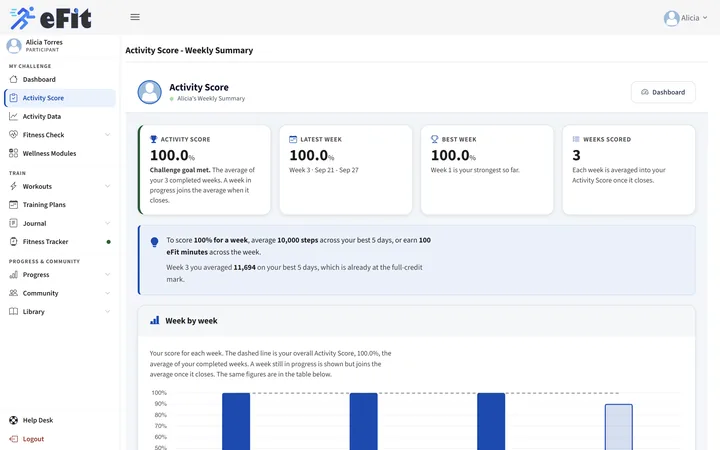
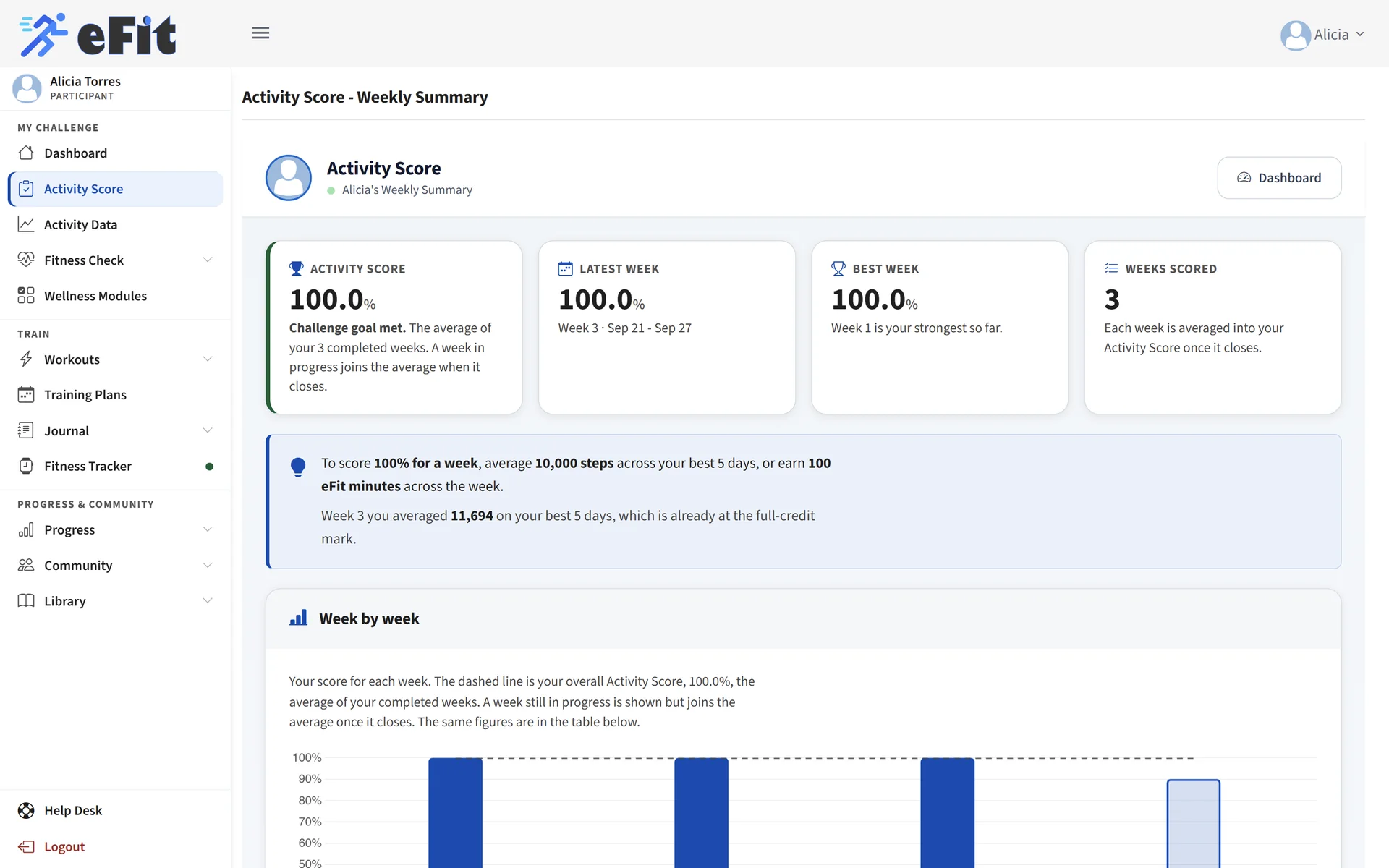
Every employee is scored against a goal they can reach.
-
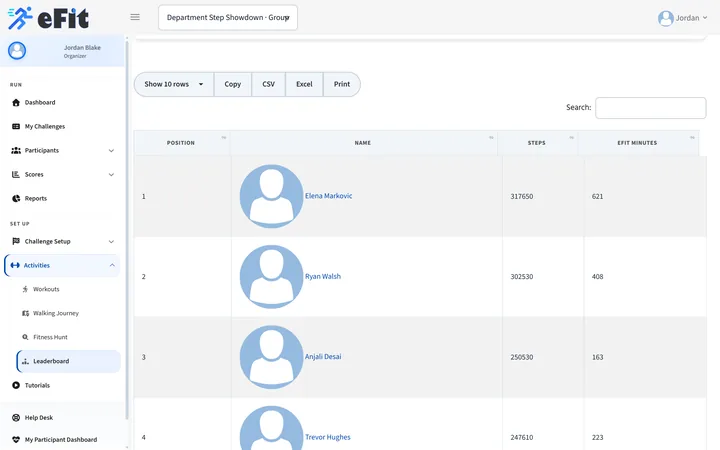
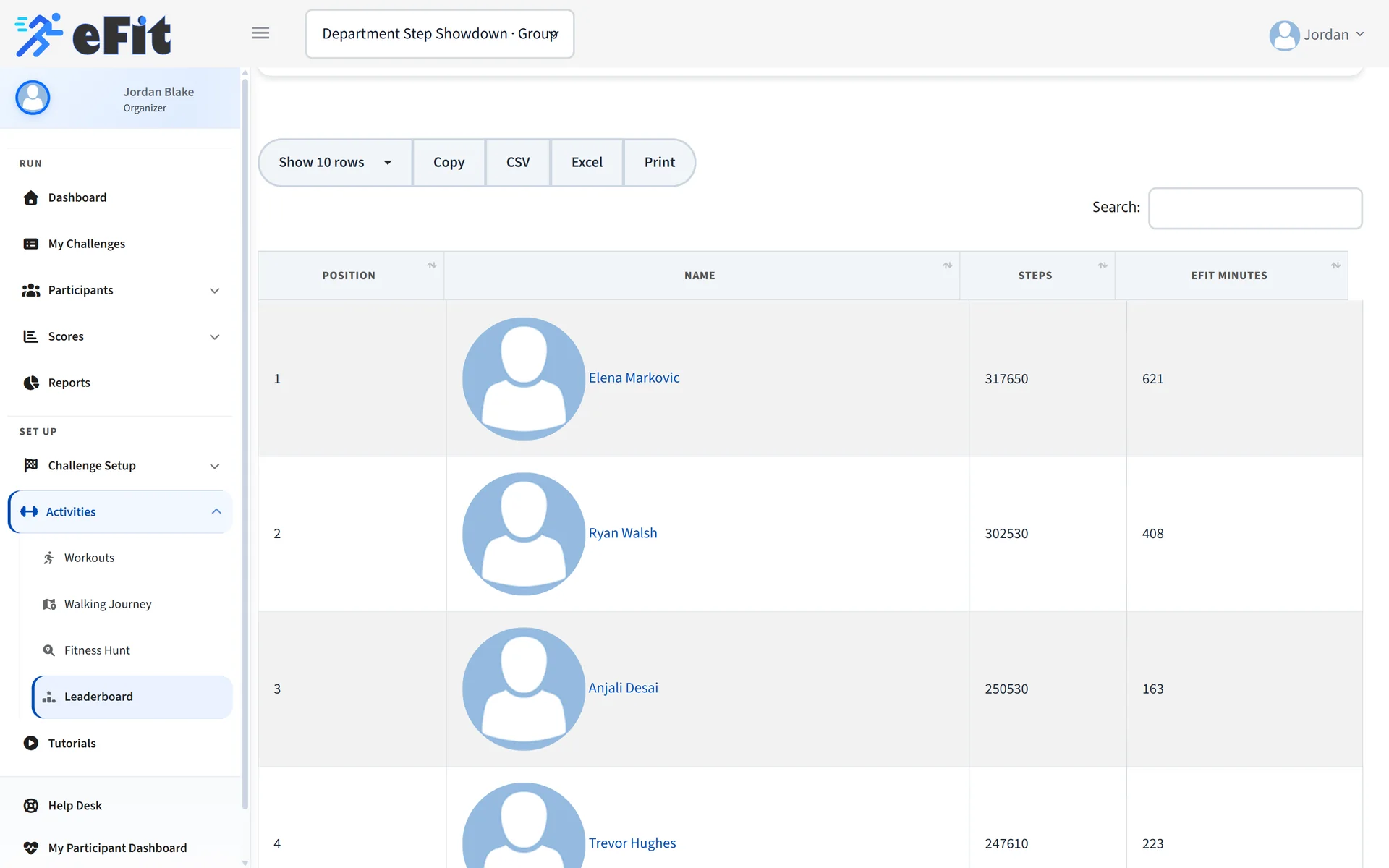
An opt-in leaderboard keeps the competition friendly.
-
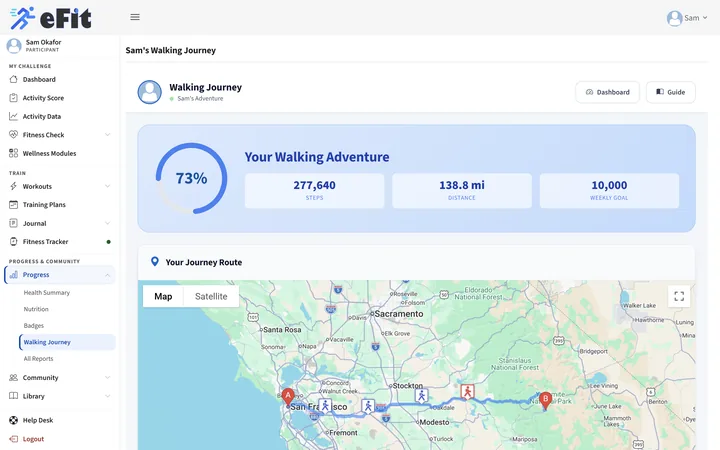
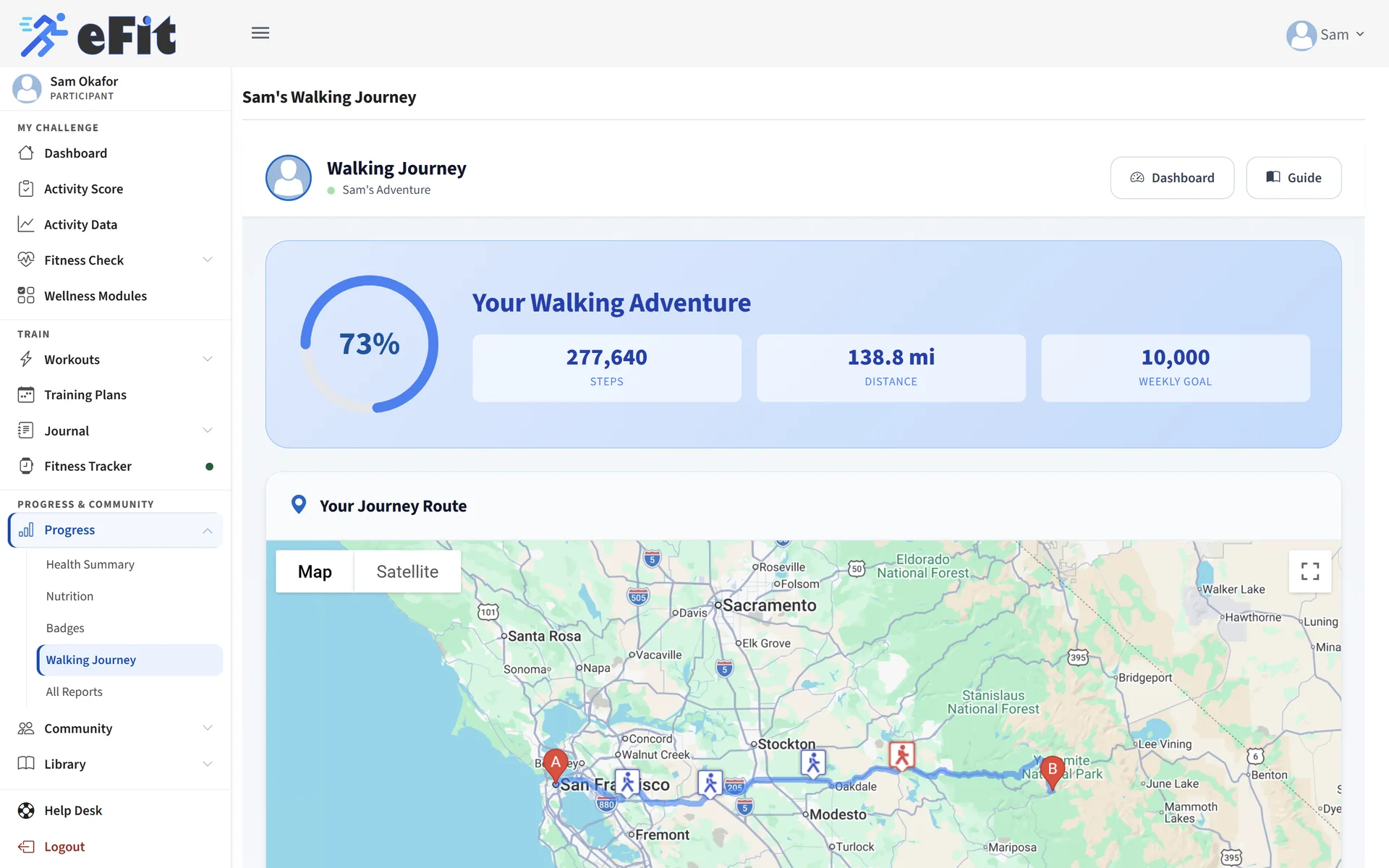
Daily steps move each person along a Walking Journey.
What a workplace step challenge is
A workplace step challenge gives coworkers one shared, simple goal: walk more, together, for a few weeks. Employees count their daily steps, teams compare progress, and the organizer celebrates everyone who finishes. Companies call it a company step challenge, an office step challenge, an employee step challenge or a corporate step challenge. The format is the same in each case.
Step challenges stay popular with HR and wellness teams for three reasons. Walking suits almost every fitness level, a phone already counts steps for most people, and a step total is easy to understand and compare. A good challenge turns those everyday steps into a few weeks of conversation, encouragement and friendly rivalry.
The short recipe: six weeks, teams of four to eight, a daily goal near 7,000 steps, automatic tracking, and recognition for everyone who reaches the goal.
Step challenge formats for the workplace
Pick one format per season. Each one runs on the same eFit setup, so you can switch formats next time.
| Format | Best for | How it is scored |
|---|---|---|
| Individual goal | Small offices and first challenges | Each person’s progress toward a daily step goal |
| Team vs. team | Most companies of 20 or more | Average Activity Score per team, so team size stays fair |
| Department rivalry | Multi-department organizations | Average score by department group |
| Location vs. location | Multi-site and hybrid companies | Average score by office or region |
| Whole-company goal | Culture and charity campaigns | Combined steps toward one destination or donation target |
| Walking journey | Long seasons and mixed fitness levels | Miles along a map route, one stop at a time |
Looking for more formats? Browse 40 fitness challenge ideas for work and groups.
Choosing a daily step goal
The popular 10,000-step target is widely promoted with little evidence behind it as a single cutoff. Research points to a lower, more reachable range for many adults. A meta-analysis of 15 international cohorts covering 47,471 adults found that the risk of death kept falling as daily steps rose, then leveled off at 6,000 to 8,000 steps a day for adults 60 and older and 8,000 to 10,000 steps a day for adults under 60.
Paluch A.E. et al., “Daily steps and all-cause mortality: a meta-analysis of 15 international cohorts,” The Lancet Public Health, 2022.
For a mixed workplace, a daily goal of 6,000 to 8,000 steps or 30 active minutes keeps the challenge welcoming for beginners and still motivating for regular walkers. On eFit, reaching 70% of the goal counts as success, so a person who starts at 4,000 steps a day can finish in good standing.
- 6,000–8,000daily steps where the benefit leveled off for adults 60 and olderPaluch et al., 2022
- 8,000–10,000daily steps where the benefit leveled off for adults under 60Paluch et al., 2022
- 70%of the goal counts as success in an eFit Activity ScoreeFit challenge scoring
How a step challenge runs on eFit
-
Create the challenge
Set the dates and the daily goal, choose whether the leaderboard is on, and add groups for teams, departments or locations.
-
Invite employees with one link
Each person registers and connects Google Health on their phone in a few minutes, with guided help. The Challenge Readiness checklist confirms your setup before day one.
-
Steps sync every day
Steps and active minutes arrive automatically from each phone or tracker app. Organizers see who is syncing and who needs a nudge.
-
Keep people coming back
Participants follow their Activity Score, earn badges, move along a Walking Journey map and check in with small accountability pods.
-
Report the results
Close with a Final Fitness Check and completion certificates, then share participation and score reports with leadership.
What to look for in a step challenge app
Compare any workplace step challenge app on these six points. Each one decides whether employees stay engaged past week two.
-
Automatic syncing
Self-reported totals create weekly chasing and disputes.
eFit pulls steps from Google Health every day.
-
Any phone or tracker
Your workforce carries every device brand there is.
Google Health covers phones and many popular tracker apps.
-
Fair scoring
Raw totals favor people who already run marathons.
Goal-based Activity Scores reward steady progress.
-
Privacy by choice
Step data is personal, and some people prefer to stay off a public board.
Each participant decides whether to appear on the leaderboard.
-
Teams and groups
Large organizations need teams, departments and sites.
Groups split the challenge any way you organize people.
-
Results you can share
Leadership wants to know what the challenge achieved.
Baseline and final fitness checks plus organizer reports show the change.
Plan your step challenge
Use the eight-step organizer guide for a week-by-week timeline, plus a step challenge template with recommended settings, rules, an invitation and weekly updates. For the evidence behind workplace challenges, read the benefits of corporate fitness challenges.
Frequently asked questions
Step challenge questions, answered.
Have a different question? Tell us about your group and we will help map the right challenge.
Email support@efit.healthWhat is a workplace step challenge?
A workplace step challenge is a friendly competition where employees track their daily steps for a set period, usually four to eight weeks, as individuals, teams or departments. Progress is shared on a leaderboard or a team goal, and the organizer recognizes finishers at the end.
How many steps a day should a company step challenge target?
A goal between 6,000 and 8,000 steps a day suits most mixed groups. A 2022 meta-analysis of 15 cohorts in The Lancet Public Health found the health benefit of extra steps leveled off at 6,000 to 8,000 a day for adults 60 and older and at 8,000 to 10,000 for younger adults.
What is the best app for a workplace step challenge?
Look for automatic syncing from phones and many tracker brands, goal-based scoring that keeps beginners in the race, an opt-in leaderboard, team and department groups, and organizer reports. eFit covers all five.
Can employees join with only a phone?
Yes. Steps come in through Google Health, which counts steps from a phone as well as many watches and tracker apps.
Should a step challenge be individual or team-based?
Teams of four to eight usually work best at work. Teammates encourage each other, and a mixed team keeps less active people involved. Individual challenges suit small offices and short mini-challenges.
How do you keep a step challenge fair?
Score each person against a personal goal, count active minutes from cycling, swimming or wheelchair activity, and sync steps automatically so every number comes from the same source.
How is a step challenge priced?
Pricing is per participant, and organizations can be invoiced for the whole group. Send your headcount and dates for a quote.
Start the conversation
Launch your company step challenge.
Send your headcount, ideal start date and team setup. We will help you choose the goal, groups and invitation.